

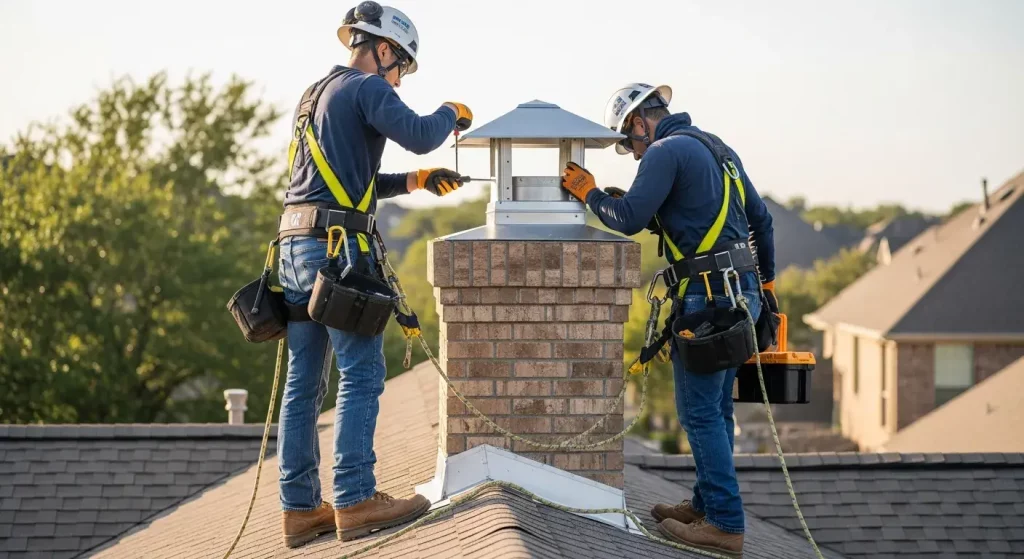
I still remember the morning I drove into Nottingham Country after a rough night of thunderstorms. The skies were still heavy and gray, and the streets glistened with leftover rain. The homeowner, a young couple who had just moved into their Katy home, greeted me with damp towels in their hands and a nervous look that I recognized immediately. They said something I’ve heard a hundred times: “We only heard a tiny drip. We figured it wasn’t serious… until this morning.”
Walking into their living room, I didn’t need more than a few seconds to catch the familiar, unmistakable smell of moisture mixing with soot — a smell that tells me water has been inside the chimney far longer than the homeowners realize. When I climbed onto the roof, it all made sense. Their chimney cap wasn’t missing, but it might as well have been. A strong windstorm had lifted the back corner just enough to let rain sweep directly under it. Rust had already formed beneath the screws, and the cap’s mesh was bent inward as if the wind had been tugging on it for months.
From their perspective, everything had looked normal from the driveway.
But up close, the damage was obvious.
That moment reminded me — yet again — why timely chimney cap installation Katy TX protects your home from costly water damage more effectively than almost any other chimney service. Most homeowners don’t realize just how fast a “small drip” turns into structural deterioration.
Where Water Damage Really Begins During Chimney Cap Installation Katy TX
Why Leaks Start at the Top, Not the Sides
It’s a natural instinct for homeowners to scan the sides of their chimney for problems — cracks, dark stains, crumbling mortar. But the truth is that water damage almost always begins at the very top, right where homeowners rarely look. In many Katy homes I’ve inspected, the cap was either loose, undersized, rusting, or missing entirely, allowing water to enter through the flue long before it shows up as a visible stain or leak inside the house.
Water intrusion is sneaky. It doesn’t announce itself. It doesn’t flood the fireplace or pour through the ceiling right away. Instead, it trickles silently down the flue walls, pooling on the smoke shelf, soaking into the firebox mortar, and seeping behind the brick façade. Months later, homeowners begin noticing small signs: a faint earthy smell, soot that clumps together, or a draft coming from nowhere. They assume it’s seasonal or normal. It’s not. It’s the early warning stage of water infiltration.
And that’s exactly why timely chimney cap installation Katy TX protects your home from costly water damage — because the top of the chimney is where the battle is won or lost.
How Katy’s Weather Accelerates Chimney Cap Failure
Heat, Humidity, and Storm Winds: The Triple Threat Every Home Faces
Katy’s climate is relentless. During the summer, the heat radiating off rooftops can easily exceed 140°F. That kind of heat expands metal, loosens screws, and warps poorly constructed caps. Then the thunderstorms hit — sometimes sideways, sometimes upward, depending on the gusts — pushing water into any seam or gap the wind can reach. And when humidity enters the equation, corrosion accelerates rapidly, especially on galvanized caps.
Over time, the problems compound quietly:
- Screws loosen from thermal expansion.
- Rust builds beneath the mounting brackets.
- Mesh screens warp from repeated wind pressure.
- Edges lift ever so slightly, enough for water to slip in.
Chimney caps don’t fail dramatically — most fail by degrees, slowly and invisibly.
That’s why so many Katy homeowners are caught by surprise. They think their chimney is fine until one storm finally reveals the truth.
The Counterintuitive Insight: A Chimney Cap Does More Than Block Rain
Most people assume a chimney cap is nothing more than a simple metal lid. But after decades in the field, I’ve learned something that surprises nearly everyone:
A chimney cap is actually a water-management system, a draft stabilizer, an ember guard, and an airflow regulator — all at the same time.
A chimney without a functional cap doesn’t just take on water.
It also suffers from:
- increased downdrafts,
- restricted draft during windy days,
- flue tile stress from sudden temperature changes,
- animal nesting and blocked airflow,
- and accelerated interior soot buildup.
This is why timely chimney cap installation Katy TX protects your home from costly water damage and also improves fireplace performance in ways homeowners rarely imagine.
The cap doesn’t just sit there. It works.
Constantly.
Silently.
And very effectively — when installed properly.
Early Symptoms of a Failing Chimney Cap (That Most People Ignore)
Sometimes the warning signs are obvious.
Most times, they’re not.
Here are the subtle early indicators I pay the most attention to during inspections:
- A musty odor after rainfall
- Damp, clumpy soot instead of dry flakes
- Small rust specks falling into the firebox
- A faint, cool draft entering the room
- Grit-like residue at the bottom of the fireplace
- Darkened mortar directly inside the firebox
Each of these signs is a clue.
Put together, they tell a story of water intrusion — quietly ongoing, slowly spreading, waiting for that one heavy storm to reveal itself in a dramatic way.
And yet all of it can be prevented with timely chimney cap installation Katy TX.
The Professional Process Behind Timely Chimney Cap Installation Katy TX
The Real Steps Experts Follow (Not the Quick Fixes You See Online)
When I’m called to a Katy home for a chimney cap installation, I never show up with a “one-size-fits-all” cap in the truck. That’s the first thing that separates real chimney specialists from general contractors. Every chimney has its own dimensions, its own airflow pattern, its own crown design, and its own history. Before I ever touch the cap itself, I start with a full assessment that tells me how the system is breathing, how the crown is shedding water, and whether the flue is properly aligned inside the structure.
Most homeowners think cap installation is as simple as placing it on top and tightening screws. But the truth is, the entire process hinges on precision — if the cap sits too low, it stifles airflow and traps moisture. If it sits too high, rain can blow inside at an angle. If it’s not anchored into solid brick (and not mortar — never mortar), wind can lift it like a loose shingle. And if the mesh is the wrong size, birds, debris, or even embers can slip through. Everything matters more than homeowners realize.
A proper cap installation isn’t a “task.” It’s a craft.
A Katy Homeowner Who Avoided Thousands in Damage — Because She Acted Early
A story I still tell homeowners today
Not long ago, I visited a home in Cinco Ranch owned by a retiree who loved her wood-burning fireplace. She told me she only scheduled the inspection because her daughter had insisted. Nothing looked wrong. No stains on the wall. No drafts. No odors. Everything seemed perfect.
But when I climbed onto the roof, I found something that made my stomach tighten.
Her chimney cap was still intact — but barely. One screw had rusted completely through. Another was holding on by a thin strip of metal. The entire cap could have blown off with one good storm.
And beneath that cap?
Hairline cracks in the crown.
Just small enough that she couldn’t see them from the ground, but large enough that the upcoming rainy season would have turned them into open channels for water. One more season, maybe two, and her flue tiles would have been compromised. The smoke shelf would have softened. The damper would have rusted shut.
When I showed her the photos, she gasped, then said softly, “I had no idea.”
Most homeowners don’t.
And that’s exactly the point — the damage begins long before anyone notices.
We installed a reinforced stainless-steel cap, re-sealed the crown, and waterproofed the brick.
A few weeks later a storm moved through, one of those heavy sideways rains that only Katy knows.
She emailed me afterward: “Bone dry. Thank you.”
She avoided repairs that would have easily cost thousands — simply because she didn’t wait.
How a Chimney Cap Protects the Crown (More Than Any Sealant Ever Could)
Here’s one of those counterintuitive insights I’ve only learned through years of hands-on work:
The chimney cap protects the crown far more than waterproof sealant does.
Most people assume the crown — the concrete top — is the most important water barrier. But the truth is, crowns crack. They expand in heat. They contract in cold. And they often fail long before homeowners ever see a visible issue.
A chimney cap shields the crown from:
- direct rainfall,
- UV exposure,
- pooling water,
- wind-driven moisture,
- and debris abrasion.
Without a cap, even a perfectly sealed crown will fail faster.
With a cap, even an older crown stays usable much longer.
So yes — sealant helps.
But the cap is the guardian.
That’s why timely chimney cap installation Katy TX protects your home from costly water damage more effectively than any other single chimney upgrade.
What Most Homeowners Don’t Realize About Storm-Resistant Caps
It’s not just the metal — it’s the method
A strong cap isn’t just about stainless steel or copper. Those help, but what truly determines longevity in Katy’s climate is installation technique. If the cap is anchored into weak mortar, it will eventually pull loose. If the mounting legs aren’t set to the right depth, wind can make them flex. If the mesh isn’t welded at the correct gauge, animals will find a way in.
And here’s something else homeowners never expect:
the slope of your roof changes how your chimney takes on wind pressure.
A steep roof creates upward lift.
A shallow roof creates sideways pressure.
Two identical caps can perform completely differently depending solely on roof pitch.
This is the kind of detail only a chimney specialist would think about, but it’s the reason some caps fail in one season while others last for decades.
The “Invisible” Storm Damage I Find All the Time in Katy
Damage you won’t see unless someone climbs up there
After every major storm, I get a series of calls from Katy homeowners who tell me, “The roof seems fine, but something smells off in the fireplace.”
That phrase — “smells off” — is usually a code for moisture trapped inside the flue or smoke chamber. And nine times out of ten, when I climb the roof, I find:
- caps that have lifted slightly on one side,
- mesh that’s bent inward by wind pressure,
- rust trails where water found a path,
- sealant that’s cracked from thermal expansion,
- and crowns that have taken on water from above.
It’s always the same pattern.
The storm didn’t create the issue — it revealed the weakness that had been forming for months.
This is why timely chimney cap installation Katy TX protects your home from costly water damage:
it prevents the first drop, not the last one.
Why I Always Tell Homeowners: “If You Don’t See a Problem, That Doesn’t Mean There Isn’t One.”
A chimney is one of the few parts of your home that can be actively damaged for months or years without showing any visible signs. Unlike a roof leak, which often reveals itself quickly, chimney leaks stay inside the structure — hidden, quiet, and persistent.
By the time signs appear inside the home, you’re already dealing with stage-two or stage-three damage.
That’s why timing is everything.
Not perfection.
Not “maybe next season.”
Timing.
The Single Square Foot That Protects the Entire System
Every time I finish a chimney cap installation in Katy, I take a moment to look at the roofline from the driveway before leaving. You can hardly see the cap from the ground — it’s so small, so easy to overlook. But I know that little square of metal is doing far more work than anyone realizes. It’s keeping storms out. It’s keeping humidity from creeping in. It’s preserving your crown. It’s protecting your flue. It’s extending the life of your entire fireplace system by years — sometimes by decades.
And all it takes is doing the job on time, not too late.
That’s the difference between a simple preventive upgrade and a costly full-scale chimney rebuild.
