
Fort Bend County has experienced remarkable growth over the past decade, and with that expansion has come a sharp increase in new residential construction — including fireplaces and chimneys. Whether a homeowner is building a new home, adding a wood-burning insert, or renovating an existing hearth, understanding the legal standards that govern chimney construction in this region is not optional. It is a matter of safety, compliance, and long-term property value.
For residents across Sugar Land, Missouri City, Pearland, and surrounding communities, knowing what the code requires — and trusting a qualified chimney sweep to ensure those standards are met — can make the difference between a cozy, safe home and a serious hazard.
Why Chimney Construction Standards Matter for Chimney Sweep Services in Fort Bend County
Building codes exist for a reason. When it comes to chimneys, the stakes are especially high. A poorly constructed or non-compliant chimney can allow carbon monoxide to seep into living spaces, create conditions for chimney fires, and put the structural integrity of a roof at serious risk. The legal standards governing chimney construction in Fort Bend County are designed to prevent exactly these outcomes.
Fort Bend County follows the International Residential Code (IRC) and the International Building Code (IBC), both of which contain detailed provisions related to fireplace and chimney construction. These codes are adopted and enforced at the local level, meaning that any construction or modification — from the foundation of the firebox to the chimney cap sitting at the roofline — must meet specific requirements.
What many homeowners do not realize is that compliance does not stop at construction. Annual chimney inspection, creosote buildup removal, soot removal Fort Bend County, and routine chimney flue sweep services are all part of maintaining a chimney in lawful and safe operating condition. That is where a certified chimney cleaner becomes an essential partner.
Top Hat Chimney And Roofing works alongside homeowners across Fort Bend County to ensure that every chimney — whether newly built or decades old — meets the standards required by local code and the National Fire Protection Association (NFPA 211). The team understands that compliance and safety are inseparable.
Key Construction Requirements for Chimneys in Fort Bend County
Before a single brick is laid or a prefabricated unit is installed, there are strict requirements that must be addressed. A local chimney sweep professional familiar with Fort Bend County regulations will recognize these immediately.
Clearance Requirements
One of the most fundamental legal standards involves clearance — the distance between combustible materials and the chimney structure itself. The IRC specifies minimum clearances from framing members, wall materials, and ceiling joists. A chimney that is built too close to combustible framing is not only a code violation but a fire waiting to happen.
For masonry chimneys, the code typically requires a two-inch air space between the exterior of the chimney and any combustible material. For factory-built or prefabricated units, the manufacturer’s installation instructions dictate clearances, and those instructions carry the force of code compliance.
Height Requirements
The “two-foot, ten-foot rule” is perhaps the most commonly referenced standard in chimney construction. Under this guideline — codified in the IRC — a chimney must extend at least two feet above any part of the roof within ten feet of the chimney, and must also clear the roof ridge and any nearby obstructions that could affect draft. These height requirements directly affect how well smoke vents from the system and prevent backdraft conditions that can push smoke and toxic gases into the living space.
A roof chimney sweep from Top Hat Chimney And Roofing can evaluate whether an existing chimney meets height requirements during an annual chimney inspection, flagging any deficiency before it becomes a compliance issue during a home sale or insurance review.
Flue Sizing and Liner Requirements
The chimney flue must be properly sized to match the appliance it serves. An undersized flue restricts airflow and promotes creosote buildup. An oversized flue can cause draft problems and condensation that accelerates deterioration of the liner. Under the IRC, flue sizing is based on the heating appliance’s output and the height of the chimney system.
In Fort Bend County, as in most of Texas, chimneys serving wood-burning appliances must have a liner — typically clay tile, cast-in-place, or a UL-listed metal liner system. Gas fireplace sweep services require different liner specifications than wood-burning applications, and mixing appliances in an unlined or incorrectly lined chimney creates serious code violations and safety hazards.
Top Hat Chimney And Roofing regularly performs wood stove cleaning and fireplace sweep service for homeowners who discover during a real estate transaction or insurance renewal that their liner is missing, cracked, or undersized. Correcting these issues is always more affordable than dealing with the consequences of ignoring them.
Chimney Sweep Inspections and the Role of NFPA 211
The National Fire Protection Association’s NFPA 211 standard is the recognized industry benchmark for chimneys, fireplaces, vents, and solid fuel-burning appliances. While it is a voluntary standard at the federal level, many local jurisdictions — including municipalities within Fort Bend County — reference or incorporate NFPA 211 provisions into their local code requirements.
Under NFPA 211, chimney inspections are categorized into three levels:
A Level 1 inspection is the minimum recommended for a chimney that has been in regular use, with no changes to the system, and is being prepared for continued use with the same type of appliance. This is the baseline annual chimney inspection that every homeowner should schedule, and it includes visual inspection of the accessible portions of the chimney interior and exterior.
A Level 2 inspection is required when any changes are made to the system — such as a change in fuel type, a new appliance installation, or after an event like a chimney fire, earthquake, or building fire. This level involves more detailed examination, including video scanning of the flue interior.
A Level 3 inspection is the most intensive, reserved for situations where a serious hazard is suspected and cannot be assessed through Levels 1 or 2. It may require removal of components to access areas of concern.
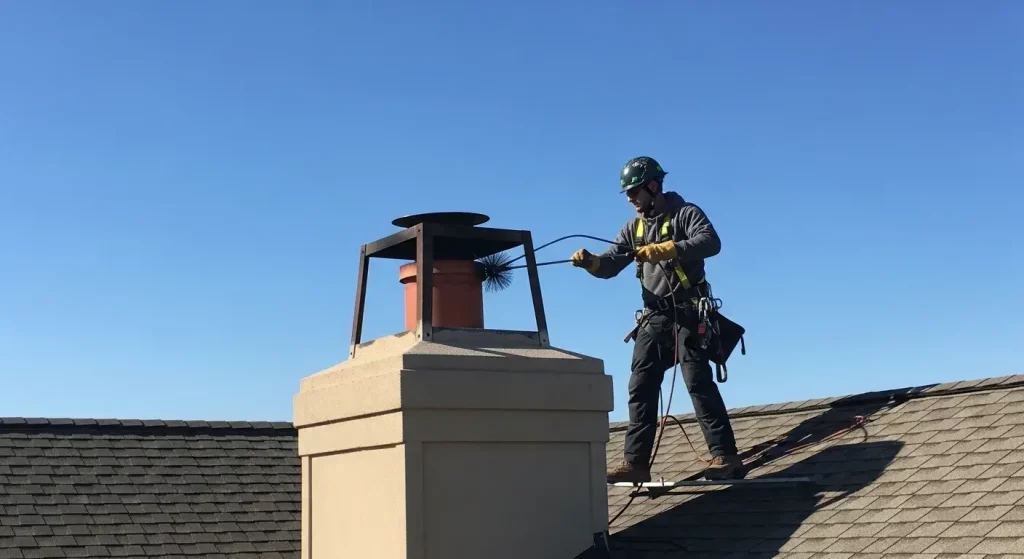
Top Hat Chimney And Roofing performs all three levels of inspection, with certified chimney cleaner professionals trained to identify the full spectrum of construction deficiencies, maintenance issues, and code violations. Whether it is a gas fireplace sweep or a full smoke vent cleaning after years of heavy use, the team approaches every job with the same thoroughness.
Permitting and the Consequences of Non-Compliance
One of the most overlooked aspects of chimney construction in Fort Bend County is the permitting process. Any new chimney construction, significant repair, or liner replacement typically requires a permit from the applicable local authority — whether that is the county itself or the specific city jurisdiction.
Skipping the permit process is a decision that catches up with homeowners eventually. During a home sale, buyers’ inspectors routinely flag unpermitted chimney work. Insurance carriers may deny claims related to fire damage if it is discovered that the chimney was constructed or modified without proper permits. And local code enforcement, when alerted to unpermitted work, can require costly remediation.
Top Hat Chimney And Roofing works with homeowners to understand what permits are required before any work begins. As Sugar Land chimney experts with deep roots in the Fort Bend County community, the team’s knowledge of local permitting processes is an asset that protects homeowners from costly surprises down the road.
Testimonial from a Top Hat Chimney And Roofing Team Member
“There was a job that still stays with me. We were called out to do what the homeowner thought was a simple fireplace sweep service — just a routine cleaning before the holiday season. When we got up there and ran the camera through the flue, we saw that the liner had completely collapsed. Not cracked. Collapsed. The family had been using that fireplace all winter, and they had no idea. Children in the house, carbon monoxide could have been filtering in for months. When we sat down with the family to explain what we found and what needed to happen, the relief on their faces — that they had called us in time — that moment is why we show up every single day. That is not just a job. That is someone’s family. And catching it before something terrible happened… that is everything.”
This kind of experience is not rare among the professionals at Top Hat Chimney And Roofing. It reflects something deeper than technical skill — it reflects a genuine commitment to the well-being of every household the team serves.
Common Code Violations Found During Chimney Sweep Inspections
Professionals performing annual chimney inspection across Fort Bend County encounter the same violations repeatedly. Understanding what these are helps homeowners know what to look for and why routine maintenance matters.
Missing or damaged chimney caps allow rain, debris, and wildlife into the flue, accelerating deterioration and creating blockages. Caps are required under most local codes and are a simple, affordable fix.
Inadequate flashing at the roofline allows water intrusion that damages both the chimney structure and the surrounding roof system. This is one of the most common sources of water damage in homes with chimneys.
Deteriorated mortar joints in masonry chimneys compromise structural integrity and allow water and combustion gases to escape into wall cavities.
Excessive creosote buildup is both a maintenance issue and a safety hazard. Creosote buildup removal is a core component of any professional chimney flue sweep, and allowing it to accumulate to third-degree levels creates a flammable mass inside the flue that can ignite under normal operating conditions.
Top Hat Chimney And Roofing performs soot removal Fort Bend County homeowners can count on, using professional-grade equipment and techniques that meet industry standards for thoroughness and safety.
Choosing a Certified Chimney Sweep in Fort Bend County
Not every contractor who advertises chimney cleaning is a certified chimney cleaner. In a market as active as Fort Bend County, homeowners should look for professionals with credentials from recognized organizations such as the Chimney Safety Institute of America (CSIA) or the National Chimney Sweep Guild (NCSG). These certifications require demonstrated knowledge of construction standards, inspection protocols, and safety practices.
Top Hat Chimney And Roofing employs certified professionals who maintain their credentials through ongoing education. When a local chimney sweep TX homeowner calls the team for service, they can be confident that the individual arriving at their door understands not only how to clean a chimney, but how to evaluate it against the legal and safety standards that govern its construction and use.
Whether the need is wood stove cleaning, gas fireplace sweep service, smoke vent cleaning, or a full Level 2 inspection following a recent chimney fire, Top Hat Chimney And Roofing brings the same level of expertise and care to every job. For Fort Bend County residents, that consistency is not just reassuring — it is a legal and safety necessity that protects families, properties, and futures.
The chimney may be one of the oldest features of the modern home, but the standards governing its construction and maintenance are very much alive and evolving. Staying ahead of those standards — with the help of Sugar Land chimney experts who know the local code landscape — is the smartest investment any homeowner can make.
