
Every time a fire burns in a fireplace, something invisible begins to build up inside the chimney flue — something that most homeowners in Fort Bend County never think about until it is too late. Creosote is a dark, oily, highly combustible byproduct of wood combustion, and it accumulates silently inside chimneys season after season. Without routine chimney cleaning, this substance can transform a cozy home feature into a catastrophic fire hazard. Understanding how creosote forms, how dangerous it truly is, and why professional intervention matters is the first step toward protecting a home and family.
The Chemistry Behind Creosote and Why Chimney Cleaning in Sugar Land Cannot Wait
When wood burns, it does not combust completely. Smoke carrying water vapor, unburned carbon particles, hydrocarbons, tar fog, and other organic compounds rises through the fireplace and up the chimney flue. As this smoke travels upward and encounters cooler surfaces near the top of the chimney, these compounds condense and stick to the flue walls. Over time, this residue hardens, thickens, and transforms into creosote.
Creosote develops in three distinct stages, and each stage presents a progressively more serious threat:
Stage One appears as a light, flaky gray or black dust. This earliest form is the easiest to remove during a standard chimney flue cleaning and poses the least immediate risk, though it should still never be left to accumulate.
Stage Two is a harder, tar-like substance that sticks firmly to the flue walls. It resembles shiny black granules or a crunchy coating. This stage requires specialized tools and is a clear signal that professional chimney soot removal is overdue.
Stage Three is the most dangerous form — a thick, glazed, almost petroleum-like coating that is extremely difficult to remove and is highly flammable. At this stage, a chimney fire can ignite with temperatures exceeding 2,000°F, hot enough to crack flue tiles, damage masonry, and spread flames into the home’s structure.
The rate at which creosote builds up depends on several factors, including the type of wood burned, how hot fires are burned, and how often the chimney is used. Wet or unseasoned wood, slow-burning fires, and cold outside temperatures all accelerate Stage One deposits transitioning into the more hazardous later stages. This is why a certified chimney sweep TX homeowners trust recommends annual chimney inspection as a non-negotiable part of home maintenance — not a suggestion, but a safety standard.
Warning Signs That Creosote Has Become a Problem in Your Fort Bend County Fireplace
Many homeowners in Sugar Land, Missouri City, Stafford, and surrounding Fort Bend County communities use their fireplaces regularly during fall and winter without a second thought about what is happening inside the flue. Creosote does not announce itself with obvious signs until a significant amount has already accumulated. That said, there are indicators worth paying attention to:
- A strong, oily, or tar-like odor coming from the fireplace — especially during humid weather — often signals heavy creosote buildup.
- Reduced drafting, meaning smoke that tends to drift back into the living space rather than drawing up through the chimney, can indicate a blockage or significant coating along the flue walls.
- Visible black, shiny residue inside the firebox or on the damper is a surface-level glimpse into what may be a much more serious accumulation deeper inside the flue.
- A chimney fire that has already occurred — sometimes detected only after the fact through cracked flue tiles, a strong acrid smell, or discoloration of exterior masonry — means creosote removal is urgent.
If any of these signs are present, scheduling a fireplace cleaning service with a qualified professional should happen immediately. Waiting compounds the risk with every fire that is lit.
Top Hat Chimney And Roofing has encountered all three stages of creosote in Fort Bend County homes, often in chimneys that homeowners believed were safe simply because they had been using them for years. Longevity of use is not the same as safety. Regular inspections are the only reliable way to know what is actually inside the flue.
The Real Risk: How Creosote Ignites Chimney Fires in Fort Bend County Homes
The most immediate danger posed by unchecked creosote is chimney fire. A chimney fire can ignite silently — burning inside the flue without the homeowner even realizing it. Or it can erupt violently, with loud cracking and popping sounds, a roaring noise resembling a low-flying aircraft, and dense smoke billowing from the chimney. Both scenarios carry devastating consequences.
When creosote ignites, it burns at extraordinary temperatures. The heat generated during a chimney fire is intense enough to warp metal flue liners, crack terracotta tiles, and compromise mortar joints. Even when the visible fire is extinguished, the structural damage left behind creates gaps through which future fires — even a normal wood fire — can allow flames and carbon monoxide to seep into wall cavities, attics, and living spaces.
Fort Bend County fireplace maintenance is not only about cleanliness; it is about structural integrity. The National Fire Protection Association (NFPA) recommends that chimneys, fireplaces, and vents be inspected at least once per year and cleaned whenever necessary. This annual chimney inspection standard exists precisely because of how quickly creosote can transition from manageable to life-threatening.
Top Hat Chimney And Roofing technicians have responded to Fort Bend County homes where chimney fires burned undetected for hours, spreading into adjacent attic spaces and threatening entire structures. The emotional weight of seeing a family’s home at risk — a home filled with memories, children’s artwork on the refrigerator, holiday decorations still in storage — is something that drives every member of the Top Hat Chimney And Roofing team to take their work as seriously as they do. Prevention is the only acceptable path forward.
Creosote Removal Sugar Land: What a Professional Chimney Cleaning Actually Involves
There is a common misconception that chimney cleaning is a simple task — something that can be handled with a long brush, a dust mask, and an afternoon. For light Stage One deposits, a basic sweep may suffice, though even then it should be performed by someone trained in chimney safety. For Stage Two and Stage Three creosote, professional-grade equipment and chemical treatments are required, and attempting to remove heavy glazed creosote without the proper tools can damage the flue lining further.
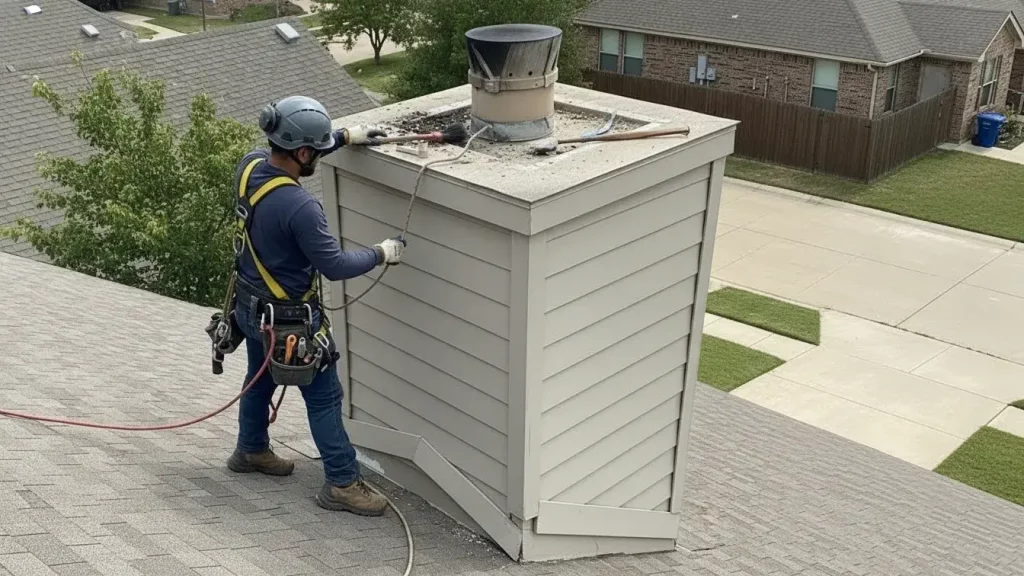
A professional chimney flue cleaning performed by Top Hat Chimney And Roofing follows a systematic process. Technicians begin with a thorough visual inspection, often using specialized cameras to examine the interior of the flue from top to bottom. This reveals not only creosote accumulation but also structural cracks, damaged mortar, blockages from debris or animal nesting, and other hazards that would otherwise go undetected.
Once the inspection is complete, the cleaning process begins. For Stage One deposits, rotary brush systems sweep the flue from the firebox upward, loosening and removing loose material. For Stage Two and Three buildups, chemical creosote removers — applied correctly and allowed to work before mechanical removal — help break down harder deposits so they can be cleared safely. Throughout the process, drop cloths and vacuum systems with HEPA filtration capture dislodged soot and debris, keeping the home’s interior clean.
Top Hat Chimney And Roofing also performs chimney soot removal from the smoke chamber and firebox, areas that are often neglected but equally important in maintaining draft efficiency and safety. After the cleaning, a post-service inspection confirms that the chimney is clear, structurally sound, and ready for safe use.
A Word From Someone Who Has Seen It All
“There was a call we got from a family in Stafford — they had bought their home just two years before and had been enjoying their fireplace every winter. They had no idea what was going on inside the chimney because, from the outside, everything looked fine. When we got up there and ran the camera down the flue, what we saw stopped us cold. The creosote was Stage Three — thick, glazed, and already showing signs of having partially ignited at some point in the past. The flue tiles were cracked. There were gaps where flames could have reached the framing of the house. That family had been sitting by a fire that was, in reality, sitting on the edge of something catastrophic. When we showed them the camera footage and explained what we were seeing, the mother started to cry. Not from fear, but from relief — because now they knew, and now they could fix it. That moment is why this work matters. Every chimney we clean, every inspection we run, every creosote removal we complete means a family gets to go to bed that night without a danger lurking above their heads. That’s not something we take lightly. Not ever.”
— Top Hat Chimney And Roofing Team Member
Why Fort Bend County Homeowners Choose Top Hat Chimney And Roofing for Affordable Chimney Service
The Fort Bend County area has grown substantially over the past two decades, and with that growth has come a surge in residential fireplaces — gas log systems, wood-burning masonry fireplaces, and insert systems that heat efficiently during cooler months. Each of these systems requires different maintenance protocols, and not every company offering chimney services has the experience or certification to handle them all.
Top Hat Chimney And Roofing is staffed by certified chimney sweep TX professionals who understand the unique climate considerations of the Houston metro and Sugar Land region. Unlike areas with harsh, extended winters, Fort Bend County homeowners may use their fireplaces infrequently — and that intermittent use actually creates conditions favorable to creosote buildup because slower, cooler fires produce more condensation inside the flue.
Top Hat Chimney And Roofing provides comprehensive Fort Bend County fireplace maintenance services that go beyond simple sweeping. Local chimney cleaners from the Top Hat Chimney And Roofing team offer full-service inspections, creosote removal Sugar Land residents trust, chimney cap installations, masonry repairs, and ongoing maintenance plans that ensure year-round protection.
Choosing local chimney cleaners with deep knowledge of the area’s homes and building styles matters more than many homeowners realize. Older homes in Sugar Land’s established neighborhoods may have deteriorating terracotta flue liners or outdated smoke chambers that require specialized attention. Newer construction sometimes includes prefabricated fireplace systems with specific maintenance requirements. Top Hat Chimney And Roofing technicians are trained to identify and address each of these scenarios with precision.
Scheduling an annual chimney inspection is the single most effective thing Fort Bend County homeowners can do to protect their families from the dangers of creosote. The process does not take long, the disruption to daily life is minimal, and the peace of mind it provides is immeasurable.
Making Chimney Cleaning a Priority Before Fireplace Season Begins
Fall arrives in Fort Bend County and the first cool evenings bring the instinct to light a fire. That instinct is natural — fireplaces add warmth, ambiance, and a sense of comfort that nothing else quite replicates. But making that first fire of the season without a prior inspection and chimney flue cleaning means lighting a fire without knowing what is sitting above it.
The best time to schedule a fireplace cleaning service and annual chimney inspection is before the burning season begins — ideally late summer or early fall. At this time, any damage from the previous season can be identified and repaired before cold weather makes the fireplace essential. It is also a period when scheduling is typically more flexible and faster.
Top Hat Chimney And Roofing encourages all Fort Bend County homeowners with active fireplaces to treat chimney cleaning the same way they treat other critical home maintenance tasks — like replacing smoke detector batteries or servicing the HVAC system. It is not glamorous, but it is essential. A chimney that is clean, inspected, and certified for use is not just a cleaner chimney; it is a safer home.
Reaching out to Top Hat Chimney And Roofing for an appointment means connecting with certified chimney sweep TX professionals who bring not only technical skill but genuine commitment to the communities they serve. Sugar Land families, Missouri City households, and Fort Bend County homeowners across the region have entrusted Top Hat Chimney And Roofing with the safety of their most important asset — and that trust is something the team honors with every single service call.
Creosote does not take a season off. Neither does the team at Top Hat Chimney And Roofing.
