

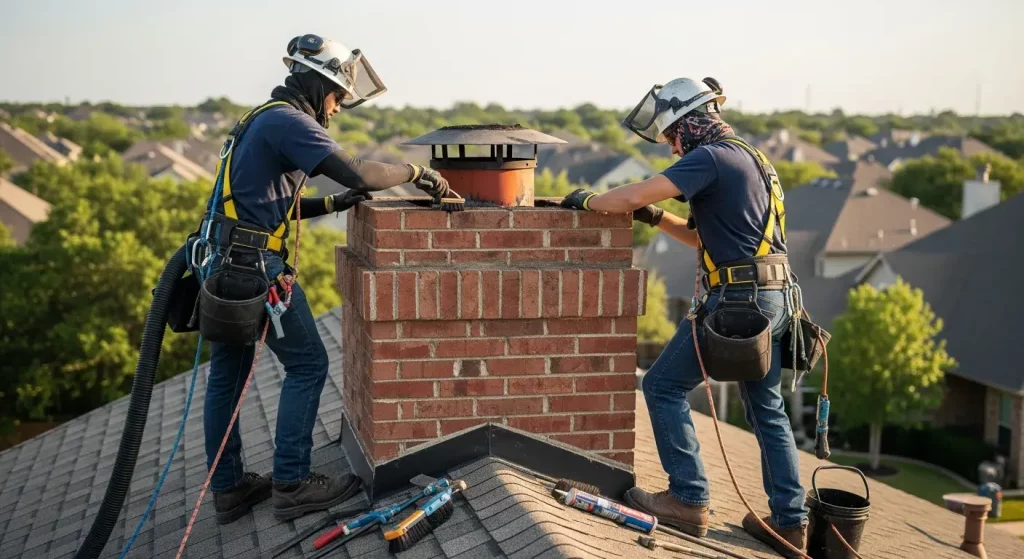
A few years ago, I was called out to a home in Richmond, just outside Katy, because the homeowners kept getting a faint smoke smell in their living room every time they used their fireplace. They assured me it was “nothing big,” that the fireplace had “always been a little temperamental,” and that they mostly wanted reassurance. I remember stepping inside and noticing how beautiful their living room was — white stone fireplace, tall ceilings, immaculate décor. Everything looked perfect.
But the moment I knelt down and opened the damper, I caught a smell I instantly recognized: not just soot, but damp soot. A sign of creosote absorption mixed with moisture — something that only forms slowly, over months or even years, when a chimney hasn’t been swept properly or when early water infiltration goes unnoticed.
When I ran my inspection camera up the flue, I watched the homeowner’s face fall. Layers of thick, glazed creosote lined the flue — the kind that doesn’t just ignite easily, but burns explosively. And the smoke chamber? Soot-packed. The damper? Rusted at the hinge. Every part of the system was telling the same story: the chimney hadn’t been maintained, and the fireplace wasn’t safe.
That’s the moment I always remember when someone asks me why Texas chimney sweep and repair services matter so much. What looks “fine” almost never is. And what looks “small” is almost always a warning sign of something bigger.
Why Texas Chimney Sweep and Repair Services Matter More in Our Climate Than Anywhere Else
Heat, humidity, and sudden cold snaps — the perfect recipe for chimney deterioration
When you work in Texas fireplaces long enough, you start to understand how uniquely challenging this climate is. Our winters are short but sharp — mild for months, then suddenly freezing overnight. Our summers are brutally hot, often cracking mortar and stressing flue tiles through thermal expansion. And our humidity? It may be the worst enemy a chimney has.
Humidity keeps soot damp, creates acidic condensation, and accelerates corrosion inside the flue. Combined with the unpredictable storms that hit Sugar Land, Katy, Richmond, and the surrounding areas, you end up with a scenario where fireplaces deteriorate faster than most homeowners ever imagine.
But here’s the twist most people don’t know:
Texas homes often use their fireplaces less frequently — which actually increases the need for chimney sweep and repair services.
When a fireplace sits unused for long stretches (especially through humid summers), creosote absorbs moisture, animals build nests, and condensation accumulates on the flue walls. A dormant system doesn’t stay clean — it slowly degrades.
That’s why year-round maintenance matters here more than anywhere else.
How Texas Chimney Sweep and Repair Services Keep Your Fireplace Efficient — Not Just Safe
A clean chimney burns hotter, brighter, and with less wood than a dirty one
Most homeowners think chimney sweeping is only about preventing fires.
And yes, that’s critical. But the part that surprises people most is how dramatically a clean chimney improves efficiency.
A properly cleaned system:
- draws better,
- burns cleaner,
- consumes less wood,
- produces less smoke,
- and sends more heat into the home instead of up the flue.
I’ve had homeowners tell me after a sweep, “Our fire has never burned this well,” and they mean it. When creosote, soot, and blockages are removed, the entire breathing function of the chimney changes. Fires ignite faster. Smoke disappears. Flames stay consistent instead of sputtering.
It’s the kind of improvement you only notice once you’ve experienced both sides.
The Counterintuitive Truth: The Less You Use Your Fireplace, the More You Need It Serviced
This is something even seasoned homeowners are surprised by:
the fireplaces with the worst buildup are often the ones that are barely used.
Why?
Because soot and creosote absorb moisture when left untouched.
Because airflow stagnates.
Because animals treat unused chimneys like hotels.
Because rust spreads slowly when dampness goes unnoticed.
Meanwhile, homeowners who use their fireplaces regularly also notice problems earlier — a sticky damper, a draft issue, smoke backflow. The signs appear sooner.
But when a fireplace sits unused for eight or nine months?
Problems grow silently.
That’s why Texas chimney sweep and repair services keep your fireplace safe and efficient year-round, even when you only light it a few times each winter.
The Silent Danger: Creosote That Becomes Glaze
A homeowner’s worst nightmare — and one of the most preventable issues
There are three stages of creosote:
- Flaky
- Crunchy
- Glazed
Stage one and two are simple to remove.
Stage three — glazed — is dangerous. It’s the thick, tar-like layer that can ignite suddenly and burn hotter than a typical house fire.
Texas humidity accelerates glazing, because damp creosote hardens faster and adheres more aggressively to flue walls.
I can’t count how many times I’ve found glazed creosote in flues where the homeowner said, “But we only used it three or four times last year!”
Exactly.
That’s the problem.
Less use + more humidity = faster glazing.
And glazed creosote rarely shows itself until it’s already dangerous.
What I Look for During a Texas Chimney Sweep and Repair Service
The expert checklist that protects a fireplace long before problems appear
A real sweep isn’t about running a brush up and down the chimney.
It’s an inspection.
A full assessment.
A safety audit.
Here’s what I inspect every single time:
- the firebox condition (mortar gaps, heat cracks),
- the smoke chamber (one of the most neglected, dangerous areas),
- the damper function,
- the flue tile alignment and cracking,
- creosote levels and type,
- animal activity,
- the chimney crown’s integrity,
- exterior mortar strength,
- flashing condition,
- cap placement and security,
- moisture levels inside the masonry.
Most homeowners are shocked when they see the internal camera footage.
They’ve been using a fireplace that looked fine — but the inside tells the truth.
The Night a Routine Chimney Sweep Prevented a Full-Blown Emergency
A few winters back, I was called to a home in Sugar Land where the homeowner insisted everything seemed fine — except for a little smoke “hiccup” when they lit the fireplace. They figured it was nothing major, but wanted a professional eye on it just to be safe. When I arrived, the family was preparing for a small holiday gathering, and they admitted they wanted the fireplace looking “extra nice.”
What they didn’t realize was that the fireplace wasn’t just struggling — it was on the edge of becoming dangerous.
As I started the sweep, my brush hit something dense — thicker than normal soot, harder than flake creosote. When I pulled the brush down, I saw it immediately: glazed creosote. The kind that forms under high heat and humidity conditions, and one of the leading contributors to chimney flue fires.
But that wasn’t the worst part.
When I ran a camera up the flue, I saw a bird nest wedged deep inside the upper chamber — dried twigs, leaves, and nesting material packed together like a tightly rolled torch. All it needed was one stray ember. One.
If they had lit that fireplace for their holiday gathering, a spark could have ignited the nest, sending a chimney fire roaring up the flue before anyone realized what was happening.
The homeowner stood there silent for a long moment, then said quietly:
“I thought we were being careful.”
They were.
But in Texas, careful isn’t enough. Regular chimney sweep and repair services are what keep “fine” from becoming “dangerous.”
That night, I cleared the flue, removed the nest, treated the glazed creosote, and restored the airflow. By the time I left, their fireplace was safe, efficient, and ready for use — without them even realizing how close they’d come to disaster.
Why Airflow — Not Wood — Determines Fireplace Efficiency
The counterintuitive truth homeowners never expect
Ask most people what makes a fireplace efficient and they’ll say one of three things:
“Good wood,” “a strong fire,” or “a proper burn setup.”
All important.
All helpful.
But none of them matter without one foundational factor:
A fireplace is only as efficient as the airflow the chimney allows.
I’ve seen homeowners burn expensive hardwood and still get smoky, sluggish fires simply because their flue was partially blocked.
Airflow governs everything:
- how fast the fire catches,
- how hot it burns,
- how completely wood combusts,
- how much creosote forms,
- and how safely smoke exits the home.
A blocked or partially obstructed flue chokes the fire.
A clean, repaired, well-maintained chimney unleashes its full potential.
This is why Texas chimney sweep and repair services are so critical here — humidity, heat, animals, and soot buildup disrupt airflow faster than homeowners ever expect.
How Repair Services Extend the Life of Your Entire Chimney System
Small repairs now prevent massive structural damage later
During every sweep, I also assess whether the chimney needs repairs. And often, homeowners don’t realize how much damage can accumulate from simple neglect — especially in Texas conditions.
These are the common issues I find that require repair:
- cracked flue tiles from thermal shock,
- deteriorating mortar joints,
- rusted dampers that won’t close properly,
- water-damaged smoke chambers,
- compromised crowns,
- loose flashing,
- or caps that shifted after storms.
Left alone, each of these problems will compound over time.
But when repaired early, the chimney’s lifespan increases dramatically.
Think of it like maintaining a car engine — small service now prevents catastrophic failure later.
The same principle applies to chimneys.
The twist?
Most chimney repairs begin with problems invisible from the ground.
Which means the only way to catch them early is through annual professional service.
Why Year-Round Maintenance Is Essential in Texas — Not Optional
Texas fireplaces operate on a different rhythm than those in colder states. We don’t use them every day in winter. We might go months — even years — without lighting them. And that “off-season” is when most damage occurs.
Here’s why:
- Humidity saturates the flue and firebox.
- Creosote absorbs moisture and hardens.
- Animals treat unused chimneys as nesting sites.
- Summer heat expands joints and cracks mortar.
- Storms loosen caps and shift flashing.
So when homeowners finally light their fireplace for that rare cold front, the system is often in worse condition than they think.
Year-round service prevents this.
It’s not excessive.
It’s appropriate for our climate.
The truth is simple:
Texas climate ages a chimney faster than fireplace usage does.
That’s why consistent chimney sweep and repair services keep your fireplace safe and efficient year-round — even when you hardly use it.
The Fireplace Isn’t the Danger — Neglect Is
Every time I finish a service call, I take one last look at the chimney before leaving. The flue is clear. The crown is sealed. The cap is secured. The airflow is restored. And I know that fireplace is now a source of comfort — not risk.
Most homeowners think danger comes from big, obvious problems.
But in my experience, the real danger is in what you don’t see.
Creosote hiding behind the flue tiles.
Moisture soaking into unseen mortar.
Animals nesting in the dark upper chamber.
Rust creeping across the damper’s hinge.
These issues grow quietly.
But they don’t have to.
Because Texas chimney sweep and repair services transform an unpredictable system into a safe, efficient, and reliable one — year after year.
That’s the difference between hoping your fireplace is okay…
and knowing it is.
